
The Disconnect: What we know vs what we do
The disconnect between what we know and what we do with strategic planning
It seems like conversations about transformation are everywhere. As a strategist, I find it genuinely exciting to see some organizations connecting their bold thinking with their strategic planning in ways I haven't witnessed before.
At the same time, many organizations have yet to take this leap. Some are focused on stabilizing operations so they are better positioned for whatever comes next. Others are experimenting with new technology to improve current-day efficiency through pilots. These efforts are critical. And yet, the pace of change suggests that the next era of healthcare will require broader shifts across the enterprise, calling for a more intentional approach to transformation.
At such a point in time, what we know and what we do may not be aligned. We can return from a conference envisioning a dramatically different future in healthcare and then go back to working against a strategic plan that falls short of charting a credible path for our own organization’s role in that future.
Why is there often a disconnect between what we know about the future and the steps we take to prepare for it?
Human cognition plays an important role here. People are naturally wired to be more responsive to near-term issues than to future risks, even when future risks come with greater potential consequences. When the future remains abstract, it becomes easier to defer attention until things feel more concrete and predictable. Over the past few decades in healthcare, changes have happened slowly enough that leaders could wait and see and still respond effectively. That assumption no longer holds. The pace of change has accelerated to the point where a wait-and-see approach is likely to create real exposure.
When there are indications of what is coming, but the dots are not connected, the future can feel too unknowable to plan for. Yet, while it may be hard to predict specific developments, the forces shaping the future of healthcare have been underway for a long time and give us strong directional guidance. These trends are likely to continue and even escalate.
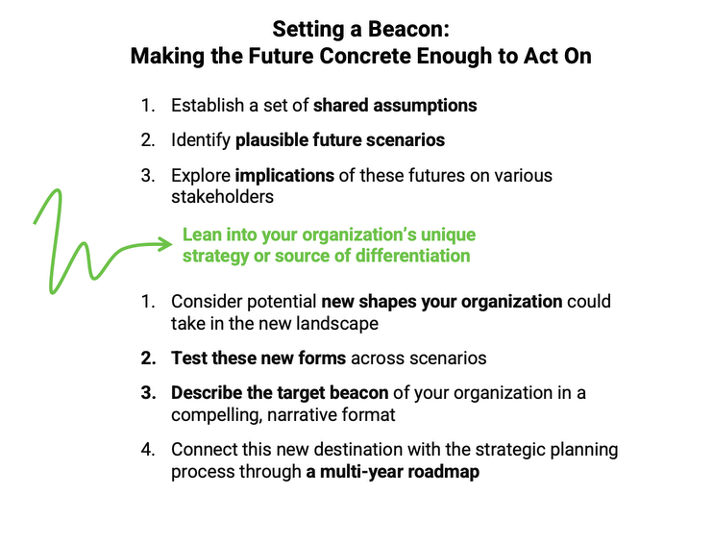
We can lean into this information to offset the natural cognitive gap and fill in the blanks ourselves. Future indicators can be shaped into assumptions and scenarios that are concrete enough for executives to discuss as potential realities. When scenarios are expressed as narratives, they become less abstract and more tangible to drive planning.
An organization can also define its own identity, role, and business model within those future assumptions. By articulating such a beacon, leaders create a shared destination that is easily understood and embraced. People across the organization are more likely to work toward a common goal when they can see and feel what they are working toward.
An organization can establish their beacon to help close the abstract-future gap using the steps below.
This kind of work requires protected time and trust. Stepping away from long-held assumptions can uncover areas of misalignment and skill gaps, which is why we encourage clients to ground the process in credible data and to create conditions for honest, collaborative exploration. A professionally facilitated process minimizes friction and keeps the group moving forward together.
Once the dots are connected, there is often a genuine infusion of purpose and energy. Because the beacon is anchored in future assumptions, it is more likely to shift the organization's course than a strategic plan enhanced incrementally year over year. A multi-year roadmap can then connect the longer-term vision with near-term planning, making the journey feel navigable.
The most striking part of this process is that it is likely to change how an organization goes about stabilizing operations and using new technology to improve current-day efficiency.
Arriving at this new destination will still require rigor in current operations, along with pilots and operational improvements. The difference is that this work is now pointed toward a bold destination that is aligned with future conditions and the organization’s mission.
What does your new future look like? Can you see it?
Nancy
If you'd like to connect, I offer 25-min strategic check-ins. These conversations are informal and not part of an engagement. You can select a time with this link.