
Persistent Trends and Variable Forces

We know more about the future than we think we do.
A board member said to me recently: “The world is so uncertain, there is no responsible way for us to be doing planning any further than one to two years out.”
I have heard versions of that sentiment more than once, and I understand where it comes from. The pace of change is real, and many of the forces shaping the current environment are difficult to predict with much precision. The statement reflects a way of thinking about the future that emphasizes more on what we cannot know and than on what is already in motion. It also risks leaving organizations in a continuous cycle of reactivity, which can limit the impact of short-term planning.
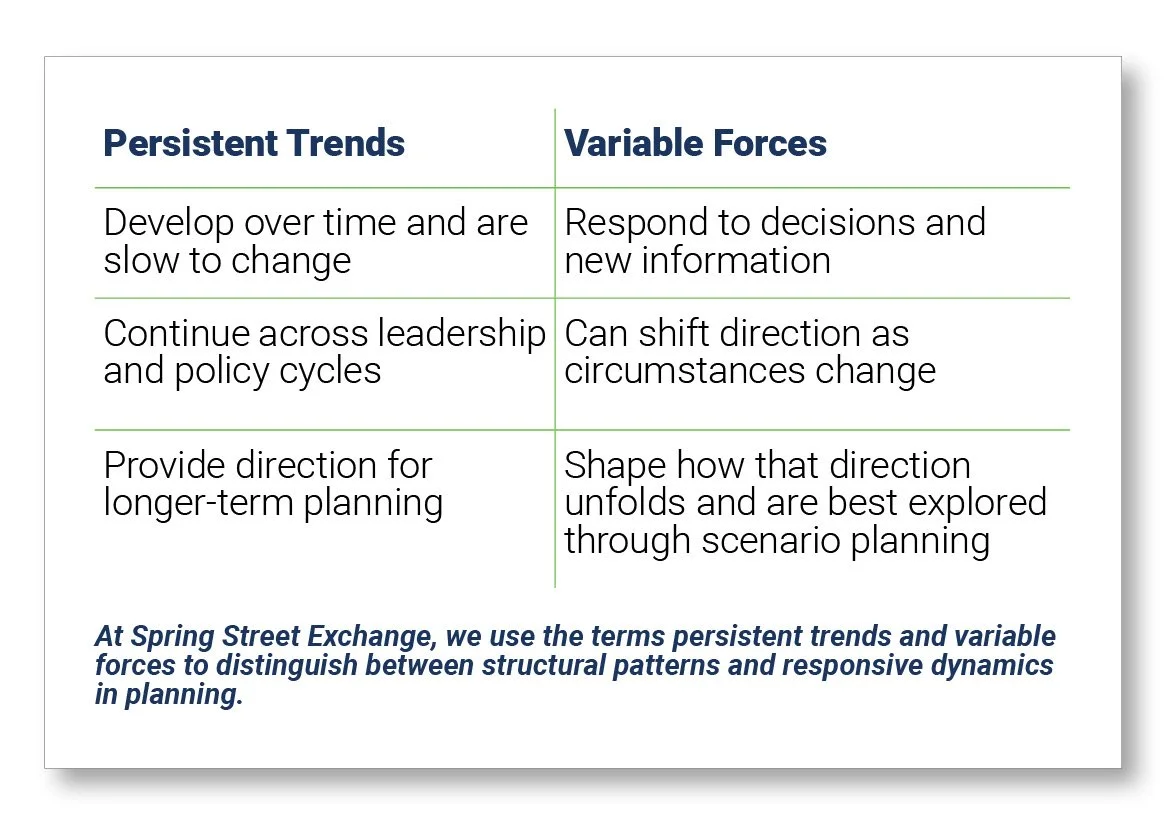
There are elements of the future that are difficult to predict, particularly when they are shaped by a complex mix of variables. For instance, we do not know who will win the next election, which merger will surprise us next, or which team will win the NBA Finals. These unknowns are driven by variable forces arising from human decisions or unpredictable inputs, and can shift direction as circumstances change. Scenario planning is a useful way to explore the implications of variable forces.
But the truth is that we know a lot more about the future than we sometimes think we do – through what I describe as persistent trends. These are forces that develop over time, continue across leadership and policy cycles, and are unlikely to reverse quickly even as the environment around them changes. They do not tell us exactly what will happen next, but they do shape the range of what is likely.
Persistent trends provide directional information about the future
Persistent trends take many forms. For instance, demographic shifts reshape demand and workforce availability over long time horizons, technology adoption follows anticipated paths, and consumer expectations continue to evolve in ways that influence how care is delivered and experienced.
At Spring Street Exchange, we organize these types of trends in healthcare using our framework, the Shifting Rules of the Road, which captures both longstanding and emerging assumptions across five domains. While these forces are also influenced by near-term variables, the framework provides a clear view of the broader trajectory of persistent forces that can be used to inform planning.
These trends are already visible across the industry, such as the shift toward care in locations of a patient’s choice, the expansion of clinical roles, and the integration of AI and other emerging technologies into the healthcare ecosystem. These represent just a subset of persistent trends with implications that unfold over multiple years and require a longer-term planning horizon.
Longer-term planning (3 to 5-year strategic plans) enables proactivity
Given all that we know about the future, limiting planning to a one- or two-year horizon may actually increase organizational risk. The board member I mentioned at the outset was responding reasonably to genuine uncertainty. But there is a difference between uncertainty about what will happen and uncertainty about what is already in motion. Persistent trends help reduce uncertainty by bringing focus to high probability pathways.
The distinction between variable and persistent forces frees us from needing to predict the future and offers a path for us to bring what we already know about it into our planning horizon. In doing this, the longer-term view inevitably changes how near-term strategic plans come together.
As many organizations gear up for strategic planning, these questions of how far out to look and what to include in a plan are surfacing. Being explicit about variable versus persistent forces offers a practical way to guide these decisions.