
Wise Thoughts for FQHCs
By Katie Poole, Managing Director and Nancy Wise, President
Does your board understand the organizational capacity required to respond to changes in primary care, healthcare policy, and the shifting landscape?
Are your board members prepared with the skills and information they need when strategic and difficult decisions arise in the coming months and years?
Has your board had a similar governance structure and approach to board engagement for many years?
For many Federally Qualified Health Centers (FQHCs), the governance structures established years ago were optimized for a different era. In today's healthcare landscape, a different approach to board composition and engagement is needed to support organizational success and sustainability.
FQHC executive teams face new demands from all angles. They must navigate shifting policies and regulations, emerging technologies, community needs, pressure from providers and staff, operational challenges, and a constant dedication to their organization's mission. Resources are never enough to meet all these needs, and the situation only grows more complex.
If the questions at the beginning of this article gave you pause, it may be a sign that now is the right time to step back and assess how well your board is prepared for the current and future environment. Many FQHCs are already facing difficult decisions and exploring compelling opportunities, and with more coming in the future. It is not easy to anticipate what comes next, so being prepared is critical.
During uncertain times, CEOs and executive teams need a board that really understands what they’re dealing with and trusts their leadership. When tough strategic decisions come up, that board should be ready to lean in and engage in a thoughtful way. Taking time now to strengthen governance and get clear on expectations can go a long way. It helps everyone stay aligned and gives leadership the support they need to navigate what’s ahead.
The table below summarizes some of the emerging expectations of community boards:
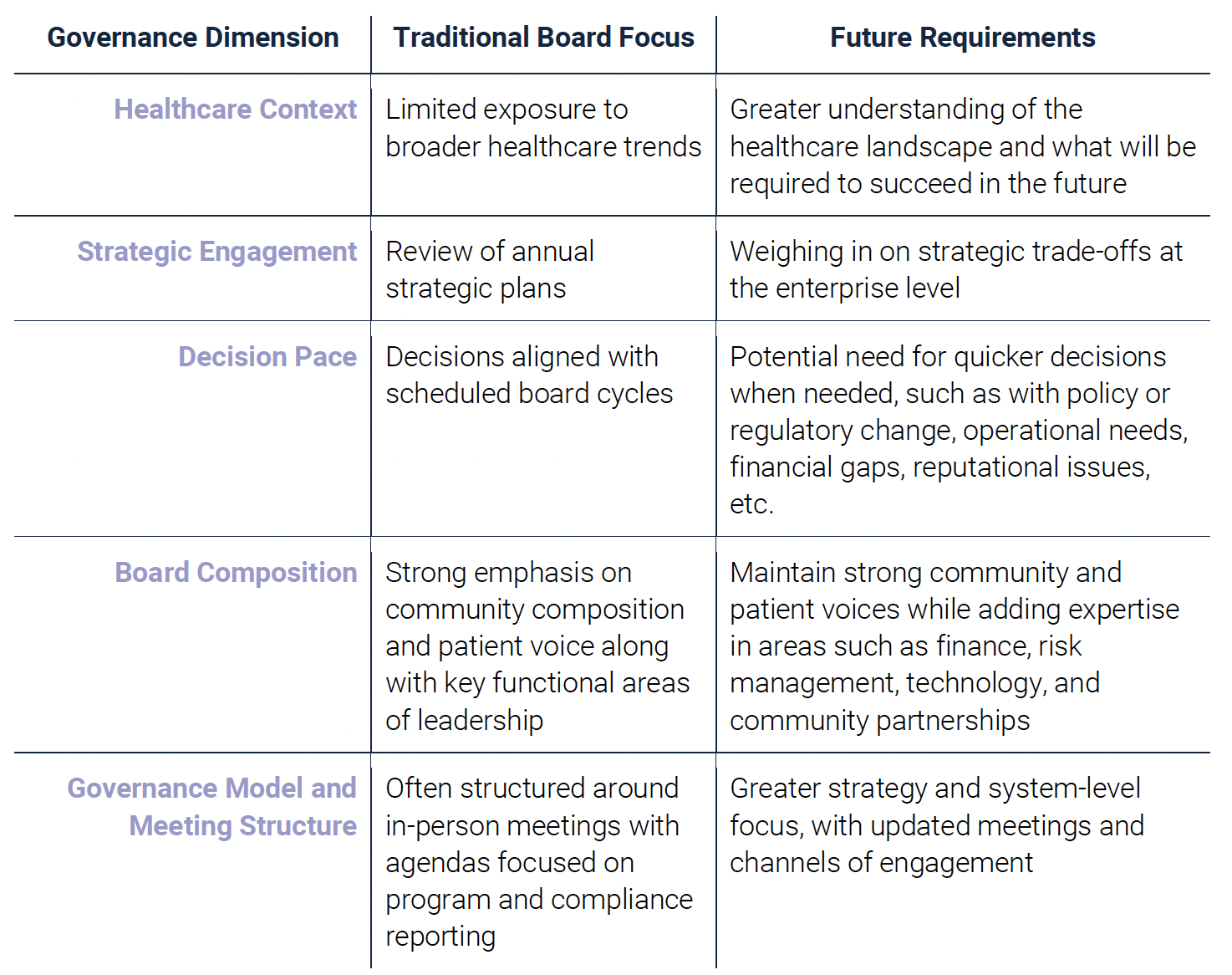
Working with a board that is more engaged in these ways will be a new role for FQHC leadership as well. Addressing all of these dynamics at once can feel overwhelming.
Many FQHCs do not have the budget or bandwidth to take on a board assessment and transformation initiative on top of their already packed agendas.
We work with nonprofit healthcare organizations around the country by supporting board retreats and workshops. We can embed work to strengthen board engagement within one of these other engagements for greater overall value and minimal additional cost. Following these combined projects, we will share observations of your current board dynamics and recommendations and options for moving forward.
At Spring Street we remain aligned in creative ways to work toward better outcomes. As we all prepare for the next era for healthcare, what are your thoughts and concerns about your organization's governance? We love the conversation!
Nancy and Katie
If you'd like to connect, Nancy offers informal check-ins - you can select a time with this link.