
We're surrounded by extraordinary changes in our world, many of which have implications that extend far beyond what we can see today. Yet when we think about what these changes mean for our organizations, we often focus on their immediate effects and how we should respond. Taking this thinking further can open doors to new possibilities that could be essential to finding a distinctive and sustainable place in an evolving landscape.
At Spring Street Exchange, we've started using a sequence of three questions to anchor our strategic thinking and help us continually explore what the future might hold.
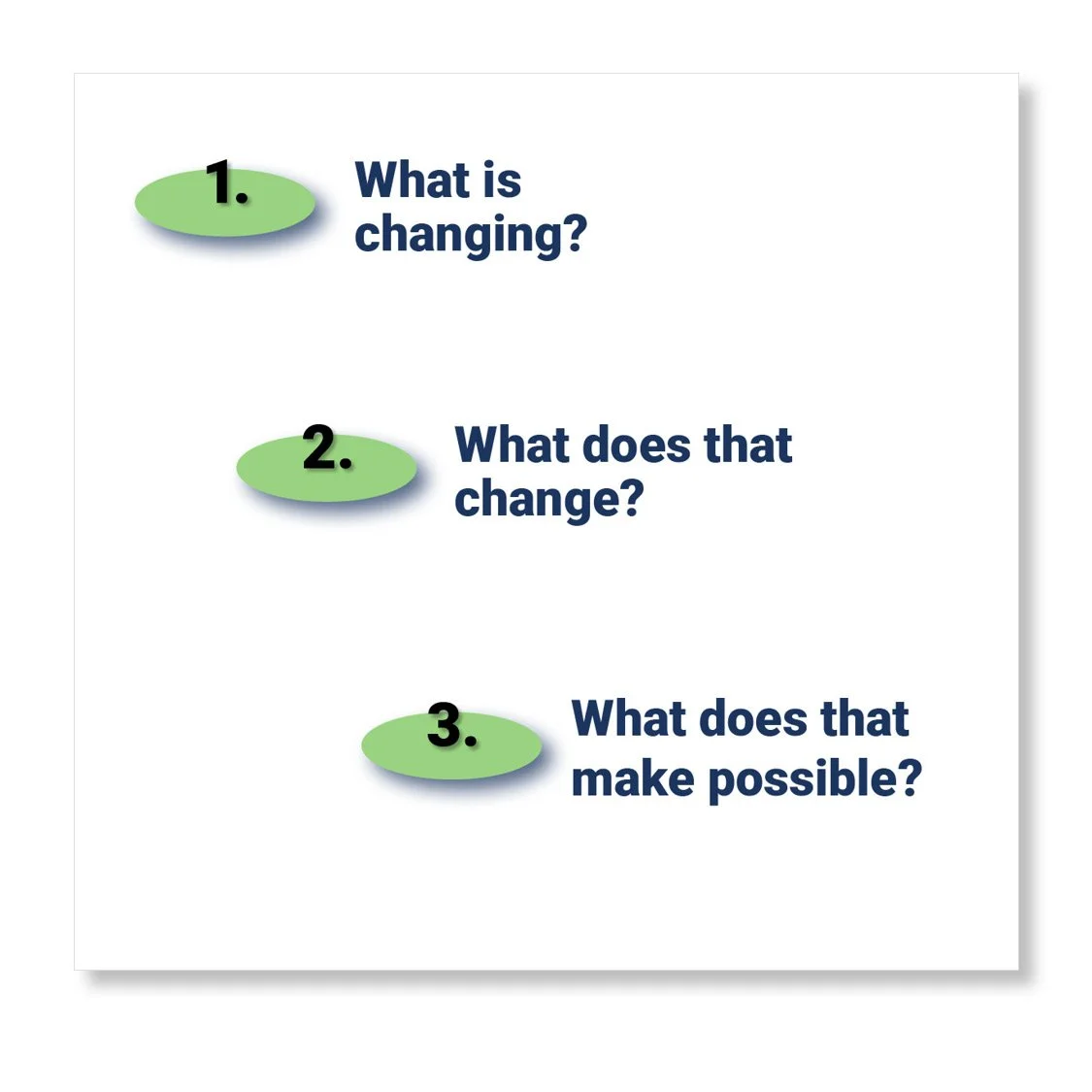
What is changing?
What does that change?
What does that make possible?
They're straightforward questions, but asking them in sequence can take our thinking into entirely new territory. We recently introduced them at our scenario planning roundtable, The Exchange, where they helped us imagine fundamentally different possibilities for the future of healthcare.
What is changing?
We're living through an unusual period in history, with nearly every aspect of our world experiencing profound change at once. That makes this an enormous question to consider. We use a framework to examine the broader forces at work in the world along with shifts within the healthcare industry. This helps us to identify areas for particular focus.
What does that change?
This is where the thinking gets interesting. If something fundamental is changing in our environment, what assumptions about our work may no longer be true? What might become less valuable or no longer necessary? This question pushes us to think consider how this change could cause us to identify new ways of thinking about both opportunities and risks.
What does that make possible?
This is my favorite question, and perhaps the one that is easiest to overlook when we get busy. This is where we can begin to imagine fundamentally different ways of organizing our work and creating value.

(Fictional image above - used as part of the extended scenario)
At our recent Exchange Roundtable, we stretched expectations by using electric aviation as an example for exploring these three questions. At first, the topic seemed far away, and as the exercise moved forward, it became common sense and imminently strategic. I'm sharing this bold example below to illustrate the point, but a similar process and accompanying exercise could play out over countless other examples.
Exploring the implications
What is changing?
Advances in electric aviation make short-distance air travel dramatically more affordable and convenient.
What does that change?
Geography becomes a much smaller barrier to moving around people and resources, challenging existing assumptions about where facilities and staffing need to be located.
What does that make possible?
Entirely new ways to organize regional healthcare systems, reconsidering which facilities and resources are shared, where people and services are located, and how care is delivered. These changes could make entirely new business models possible.
Applying these questions for strategic advantage
This is just one example of a single shifting technology. Advances in artificial intelligence, robotics, at-home diagnostics, energy storage, and more also challenge longstanding assumptions about how we operate and what’s possible. With so much change in motion, there is an extraordinary opportunity to rethink what the future could look like and discover new paths for strategic differentiation.
We're bringing these questions into more of our work at Spring Street Exchange, and they seem to resonate and invigorate each time. They have a way of opening up our thinking and bringing more creativity into the room. They help us move from imagining what might be possible to considering what we could actually do differently.
In doing so, they make the future a much closer and more interesting place to explore. In an industry with shrinking margins and growing competition, these questions chart a path to the kind of bold thinking that the times require.
What is changing? What does that change? What does that make possible?
-----
Nancy also works one-on-one with a small number of healthcare executives as a strategic advisor and thought partner. You can connect with her to learn more at connect@springstreet.exchange.